Tuesday’s stock market decline occurred as investors evaluated the minutes of the most recent Federal Reserve meeting, in which participants did not hint at potential rate reductions.
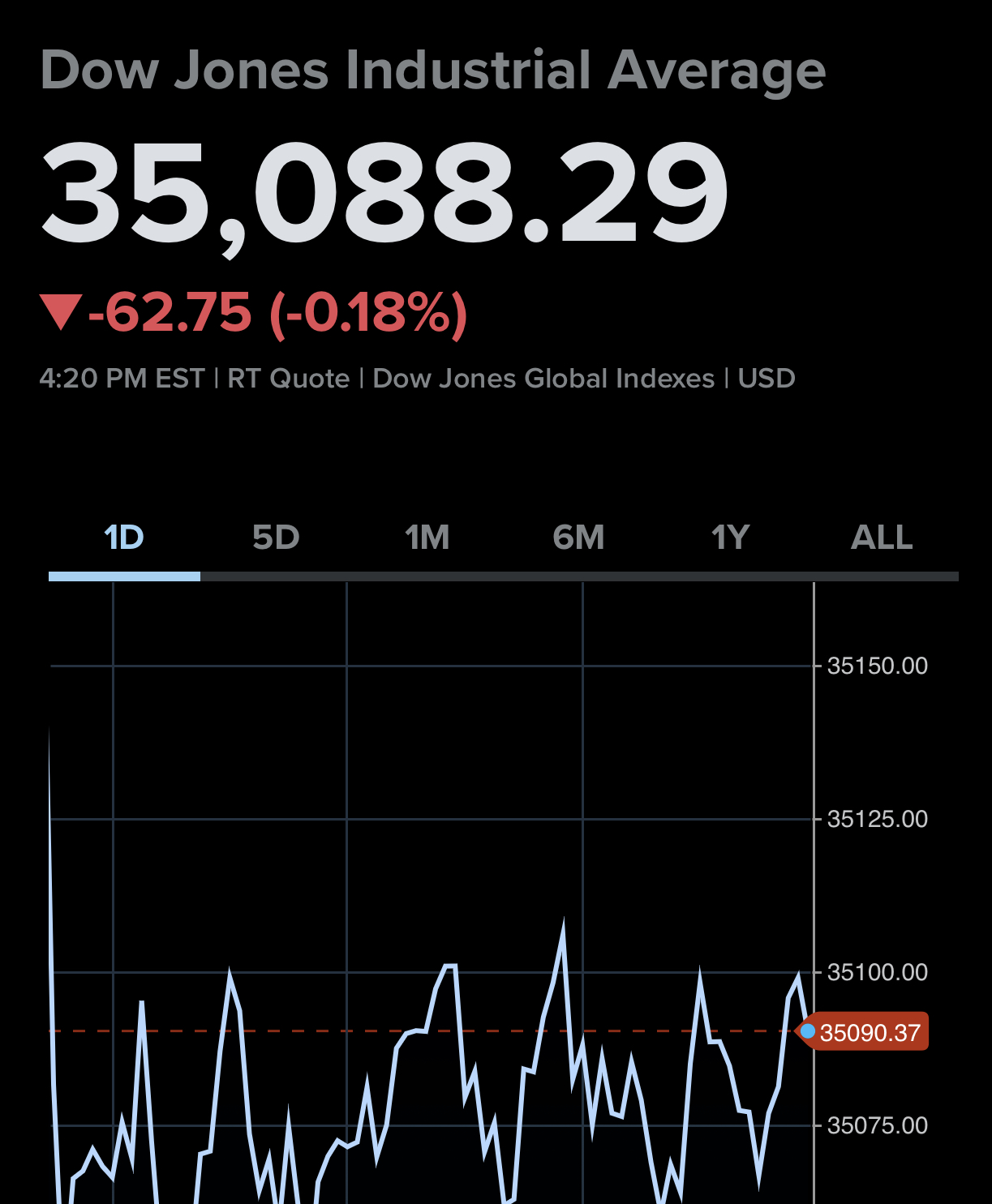
A loss of 62.75 points, or 0.18%, saw the Dow Jones Industrial Average close at 35,088.29. In contrast, the Nasdaq Composite dropped 0.59% to 14,199.98, and the S&P 500 shed 0.20% to close at 4,538.19. Five days of winning streaks were broken by the broad-market benchmark and the tech-heavy Nasdaq.
The Fed stated that “restrictive” policy will be necessary because of worries that inflation may be persistent or even slightly higher. After their meeting from October 31 to November 1, policymakers decided to keep the benchmark rate between 5.25% and 5.5%.
According to the minutes, “during the policy outlook discussion, participants were convinced that the monetary policy stance must be sufficiently restrictive to gradually bring inflation back to the Committee’s 2 percent objective.”
The Federal Open Market Committee is almost unanimous in its prediction to remain steady at its December meeting, according to Fed funds futures pricing, which is pricing in cuts beginning in May.
We might be experiencing a rare but profound generational regime change right now. Senior portfolio manager at Exencial Wealth Advisors Jon Burkett-St. Laurent added, “And it’s probable that we’re not going back to zero rates.” While rates are likely to be more volatile now than they were for the majority of the previous ten years, this doesn’t necessarily imply that they will rise to 20% in a straight line.
According to housing data, last month was challenging for potential homeowners as rates remained “higher for longer.” The National Association of Realtors reports that October existing home sales were 3.79 million units, compared to projections of 3.9 million. Since August 2010, the sales rate has been the slowest, and a 14.6% decrease from the year before.
Source (CNBC)