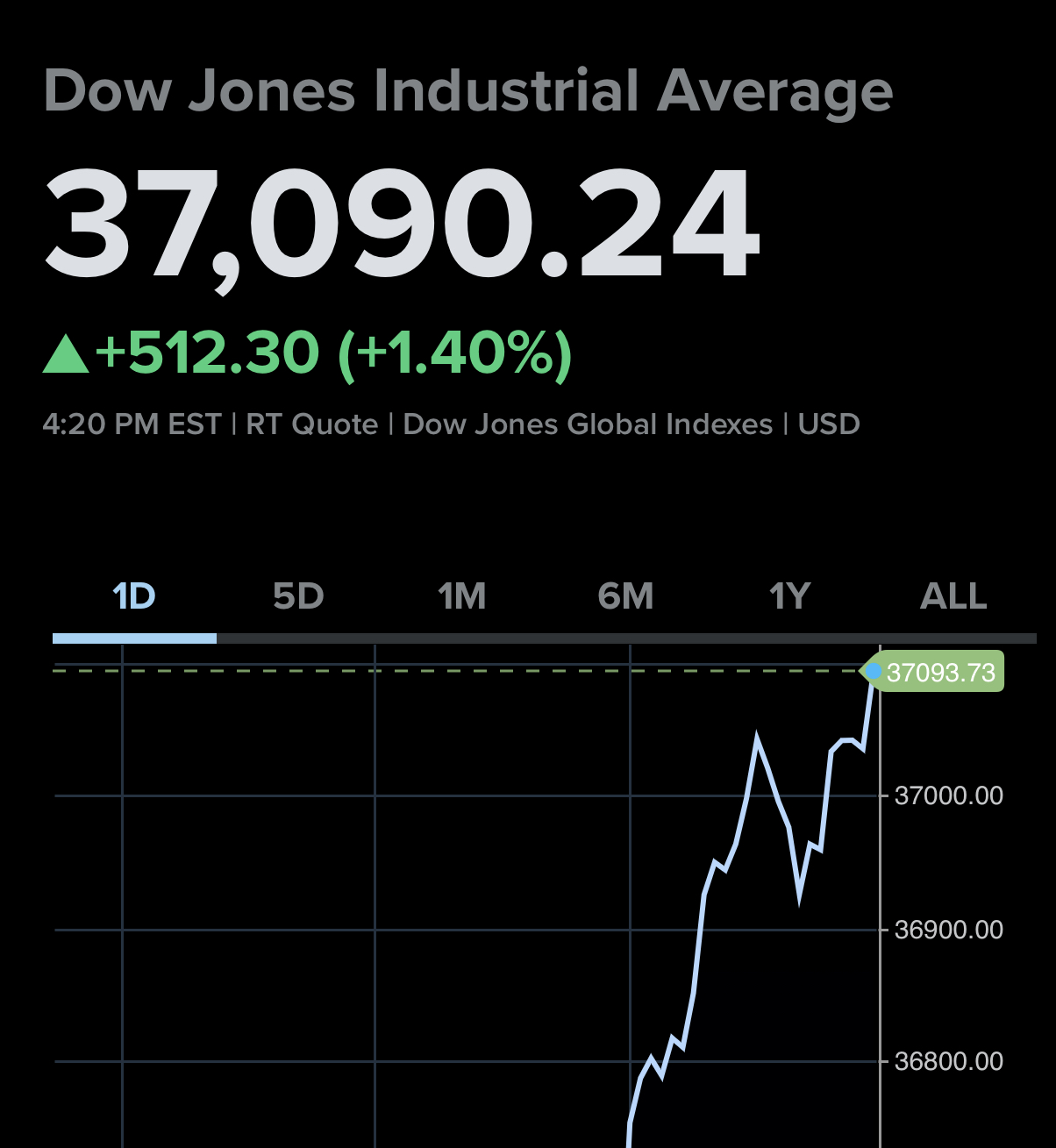
Dow Jones Industrial Average surged to a new record high on Wednesday after the Federal Reserve indicated its intention to implement multiple rate cuts next year. This decision by the central bank has satisfied investors who were eager to see a more accommodative monetary approach that acknowledges the slowing trend of inflation.
The Dow, comprising 30 major stocks, recorded a gain of 512.30 points or 1.40%, closing at a milestone of 37,090.24. The index even touched a peak of 37,094.85 during the day, surpassing both the 37,000 mark for the first time and its previous all-time high achieved in January 2022. Simultaneously, the S&P 500 also experienced a notable increase, rising 1.37% to end the session at 4,707.09. This marked the first time it crossed the 4,700 threshold since January 2022. The Nasdaq Composite followed suit and climbed 1.38% to reach 14,733.96. All three major indices achieved fresh 52-week highs.
While the Federal Reserve maintained the overnight borrowing rate within the anticipated range of 5.25% to 5.5%, the crucial aspect of their announcement was the projection of three rate cuts in 2024. This was a larger number than what was previously indicated. Investors have been increasingly hopeful for a clearer signal from the Federal Reserve that it plans to commence rate reductions next year, particularly due to recent easing in inflation data.
The Federal Reserve’s meeting statement recognized that inflation has eased over the past year, and they formally revised their inflation forecast for 2024. The new projection anticipates a 2.4% rate, a decline from the previous estimate of 2.6%.
Gina Bolvin, President of Bolvin Wealth Management Group, expressed optimism about the Federal Reserve’s shift, stating, “The Fed has given the market an early holiday gift today when, finally, for the first time, they have commented positively about inflation. It appears that the Fed is moving in the market’s direction, rather than the market moving towards the Fed. The Santa Claus rally may continue.”
Source (CNBC)